

Author: Bella Webb
The new Foundstock Standard was launched by Aloqia to bring consistency and credibility to how “deadstock” is defined and used.
Can a new industry standard change the way fashion uses deadstock?
In recent years, the term ‘deadstock’ has been misinterpreted and overused, leaving brands vulnerable to greenwashing accusations. A new standard hopes to fix that, and maximise reuse in the process.
By Bella Webb
September 4, 2025
At first glance, fashion brands working with deadstock materials is a rare win-win for both the planet and the industry’s profit margins. When deadstock — or unsellable inventory — is repurposed, it stops the environmental damage used to produce those materials from going to waste, and in an ideal world, also displaces virgin materials. On the financial side, brands are able to recoup some of their losses from overproduction and avoid sending expensive materials to landfill or incineration.
But criticism of deadstock has been mounting in recent years. The term has been overused and misinterpreted, referencing everything from industrial waste to unsold products, with little transparency over when, where or how it was produced. There is also a debate around how long materials need to be sat unused before being considered deadstock, when in the production journey those materials ought to be intercepted, and to what degree using deadstock can be marketed as a sustainability play. All of this has left the sector susceptible to greenwashing.
A big part of the problem is that deadstock doesn’t have an official definition, says Stephanie Benedetto, co-founder and CEO of inventory management platform Aloqia (formerly deadstock marketplace Queen of Raw). On 5 September, Aloqia is launching a new platform called the “Foundstock Standard” in an attempt to establish a consensus on what exactly deadstock is, and incentivise its reuse. Central to its work is reframing waste as a resource, rather than “dead”.
Aloqia’s proposed definition of “foundstock” is currently a 20-page working document — available in full on the standard’s new website — which will be reviewed and updated by its advisory board and independent auditing partners over the next six months. However, at its core, foundstock is defined as unused, pre-consumer textile materials such as yarns, fabric rolls or raw goods that were produced but never used, shipped or sold. This also includes unfinished items that were developed for a specific purpose, but were set aside or discarded before fulfilling that purpose, and have been held in storage for at least 90 days.
Depending on the level of traceability and the documentation provided alongside deadstock materials, brands using the standard will be awarded silver, gold or platinum status. Crucially, certified foundstock can only be sold at the same price or lower, to avoid incentivising brands to produce deadstock for profit.
The platform is open to the whole industry, for a yet-to-be-determined fee, and companies do not need to be an Aloqia client to gain access. The two organisations will remain separate legally and financially, Benedetto says.
The need for a harmonised definition is clear. Brands selling into the European Union will soon have to consider what happens to their products post-purchase under the new extended producer responsibility (EPR) rules. The circular infrastructure required to comply will create meaningful avenues for waste at every stage of the supply chain, including deadstock, the majority of which is currently resold, wasted, sent to landfill or incinerated.
Meanwhile, despite some flip-flopping by the European Commission — largely related to how widely new regulations should apply — the stakes for greenwashing are only getting higher. Shein was recently hit with a €1 million fine for greenwashing (it said it took immediate action to address the concerns raised and has improved its website to ensure that all environmental claims are compliant with regulation). And as of April 2025, the UK watchdog, the Competition and Markets Authority (CMA), has the power to fine businesses up to 10 per cent of their worldwide turnover for greenwashing.
And for US brands, there’s an additional incentive to identify and utilise deadstock: with tariffs making it more difficult and expensive to import products, fashion businesses are looking at what is already available domestically. While the US has limited raw materials appropriate for fashion production, what it has in abundance is waste, of which deadstock makes up a significant proportion.
A work in progress
Aloqia has clear stakes in the game. Originally founded as Queen of Raw in 2014, the US-based company rebranded in 2024 to reflect its growing B2B business, developing software that enables brands such as Nike, Ralph Lauren and Victoria’s Secret to manage excess materials at scale.
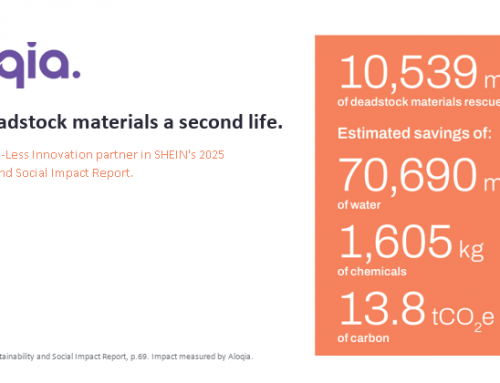
In 2022, Aloqia announced a controversial partnership with Shein, which it says has helped the ultra-fast fashion giant divert over 32,000 metres of deadstock fabric. Critics questioned whether the use of deadstock fabrics from other brands was sufficient to offset the waste created by Shein’s broader business model, and raised concerns over how the use of deadstock was marketed, pointing out how difficult it is to make credible claims about the virgin resources displaced by using deadstock without accurate lifecycle assessments.
Aloqia, formerly Queen of Raw, is hoping to make deadstock more traceable and transparent with its new Foundstock Standard. The ultimate aim is to drive reuse and minimise waste.

Photo: Lluis Gene via Getty Images
Benedetto says the marketing of brand partnerships is outside of Aloqia’s remit, but the Foundstock Standard will include best practices on how to communicate the use of certified materials. She also notes that broader business practices will be built into the Foundstock Standard’s three tiers. While the exact details will be ironed out during the pilot phase, the idea is that brands with worse environmental and social impacts outside of their use of deadstock will be denied the certification, or capped at lower tiers, depending on severity.
She also emphasises that, while Aloqia instigated the Foundstock Standard and has been driving its rollout, much of the backstage work has been undertaken by third-party auditors Control Union and Peterson. The process started with a landscape analysis of existing rules and regulations around deadstock, highlighting the lack of a standardised definition. Then, the auditors interviewed representatives from Aloqia and a wide-ranging consortium of fashion brands to understand the different definitions currently at play, and common points of fracture.
“That process included smaller and larger companies, all the way from mass market to luxury, spanning from Europe to Asia, and even extending to supply chain partners of the brands involved,” explains Benedetto. “It’s very important to us that all of those voices are heard.”
The names of consortium members will be kept under wraps until the public consultation (which goes live today) closes before the end of the year. This is to avoid biasing public opinion on the standard, at the recommendation of Control Union and Peterson. Once the consultation is complete — likely in the new year — Aloqia will unveil the standard’s consortium partners, advisory council and pilot programmes.
“Without a clear definition, how are you going to measure, report and comply with regulatory requirements going forward?”
When the pilot programmes come into play, participating brands will road-test the standard’s certification and platform. Some will centralise their deadstock for internal reuse, while others will identify deadstock to sell it on. Either way, transparency and traceability will be key, says Benedetto, noting that the Foundstock Standard will also monitor how much deadstock companies are producing and whether this decreases over time.
The pilot programmes have a lot of kinks to work out, including the exact fees for certified brands and whether brands will be able to repurpose all of the deadstock they find. Older materials which were made before certain regulations came into play will have to reckon with their chemical heritage, which could render them inappropriate for contemporary consumers. Benedetto says quality assurance and content testing are part of the process. How this works in practice — especially when deadstock appears in small pockets all over the world, often buried deep in supply chains — will be determined during the pilots.
If these questions are answered, a unified standard could help unlock progress and curb waste, says Benedetto. “The definition of deadstock was a huge white space,” she explains. “The idea for the pilots is to figure out whether the definition we have come up with actually works. Which elements are too hard or too easy to meet? What needs to change so that everyone can participate?”
There is scope for the definition to inform more progressive regulations in future and raise the industry’s ambition, she adds. “Without a clear definition, how are you going to measure, report and comply with regulatory requirements going forward?”
Link to the full article here.